

Sirat-e Jalāl al-Din Mengübirni (Sirat-e Jalal al-Din Minguberni)
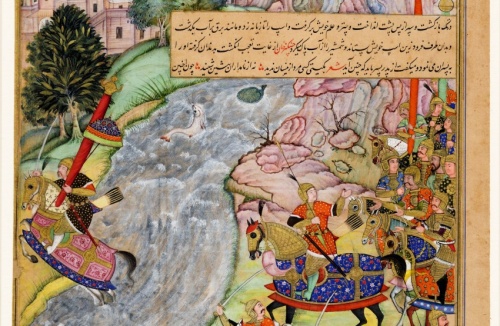
The primary source on the history of the Khwarazmshāh dynasty (1077-1231) during the last
years of Sultān Mohammad's rule (1200-1220) and the reign of Sultān Jalāl al-Din (1220-1231).
The author, Nasawi, came from a prominent family in Khorasan, where they owned the Khorandez castle in Zaydar, one of the districts of Nesā (Nasawi, 2005: p.45). Therefore, he was known as Nasawi Zaydari Khorandezi. Early on, he began working as a bureaucrat, serving Ekhtiār al-Din Zangi ibn ‘Emad al-Din, the governor of Nesā (Nasawi, 2005, p.87; Nasawi, 1991, pp.57-58), and later for Nosrat al-Din Zangi ibn Mohammad (Nasawi, 2005, p.132). Nasawi joined Sultān Jalāl al-Din in 1225 (Nasawi, pp.95-97) and served as the director of Diwan-e Ensha (Nasawi, 2005, p. 140). When the Mongols invaded Azarbāijan, Nasawi fled to Âmed under the Saljuqs of Rome (1077-1307), where he learned of Sultān Jalāl al-Din's death in 1231 (Nasawi, 2005, pp.274-78; Nasawi, 1991, pp.210-212).
Nasawi wrote his historical works while serving the Saljuqs of Rum. There, he wrote Nafsat al-Masdur and some chapters of Sirat-e Jalāl al-Din Mengübirni between 1235 and 1241 (Nasawi, 1991, p.116). He completed the last chapters of Sirat-e Jalāl al-Din Mengübirni when he joined the service of Hesām al-Din Beker Khan Khwārazmi, the governor of Âmāsiyeh, in 1241 (Nasawi, 2005, 155; Ibn Bibi, 1956, p.489). In the last years of his life, he served Al-Nāser al-Asghar Yusef ibn al-Aziz al-Ayūb in Halab and died there in 1249 (Nasawi, 2005, p.31).
History of the work and its edition: Sirat-e Jalāl al-Din Mengübirni was originally written in Arabic. In 1891, O. Houdās, the French teacher of Oriental languages, found a copy of the original Arabic text and published it. The manuscript Houdās used was written in 1269 (Nasawi, 1946, p.9). In 1953, Hafez Hamdi reedited the same manuscript and published it in Egypt. It contains an introduction and 107 chapters. He added critical explanatory footnotes for proper names, bureaucratic (diwani) expressions, and events to give readers a clearer understanding of Nasawi's reports. Mohammad Ali Nāseh, the director of the Literary Association of Iran (Anjoman-e Adabi-ya Irān), translated Houdās's edited work into Persian in 1946 (Nasawi, 1946, p.11). It has also been translated into French and Russian (Nasawi, 1996; Nasawi, 1891-1895). The Arabic version of Sirat-e Jalāl al-Din is very expressive, full of rhyme and metaphor (Nasawi, 1953, p.25). He uses Qur’ān verses and Arabic poetry to support his accounts of the events (Nasawi, 1953, p.27).
Sirat-e Jalāl al-Din was translated into the highly expressive Persian language by an anonymous person in the late 13th century. Mojtabā Minovi, a professor of Persian language and literature at Tehran University, discovered a single manuscript of the book in the personal library of Makermin Khalil Yenanj, a history professor at the University of Istanbul. He edited and published it in 1966 (Nasawi, 2005, pp.8-9; Khosrowbeigi, 2006, p.88). The edition includes the introduction, 89 chapters, and the appendix (Ta’liqāt). Compared to the Arabic original, the Persian translation omits some parts, mainly Nasawi’s autobiography (Nasawi, 2005, p.10). The translation is written in the rich, poetic language of the 13th century, featuring many poems that are not present in the Arabic text. As Minovi notes, the Persian translation by an anonymous author is based on a more reliable Arabic version than the one available to Houdās (Nasawi, 2005, p.10). Therefore, in this entry, we will reference both the Arabic text edited by Hafez Hamdi and the Persian version edited by Mojtabā Minovi.
Content: Sirat-e Jalāl al-Din Mengübirni is one of the most important works of Nasawi. Along with Tārikh-e Jahan-gosha by Ata Malek Jovayni and Tabaqat-e Nāseri by Menhaj al-Sarāj-e Jowzjāni, it is one of the main primary sources on the Khwarazmshāh. It details the history of the Khwarazmshāhs from the time Sultān Muhammad engaged in conflicts with the Mongols, referred to as Tatars (Nasawi, 1953, p.38; Nasawi, 2005, p.6), until the fall of the Khwarazmshāh with the death of Jalāl al-Din (1220-1231) (Nasawi, 2005, p.4).
The detailed analytical report by Nasawi, based on events he personally witnessed, highlights the unique value of his work. In his book's introduction, Nasawi explains that he initially aimed to write a general history. However, upon reading Al-Kamil fi al-Tārikh by Ali ibn Athir, he changed his mind and decided to focus on a dynastic history of the Khwārazmians during the rule of Sultān Muhammad and specifically Jalāl al-Din (Nasawi, 1953, p.34; Nasawi, 2005, p.13). Nasawi stresses that he reported only events he personally observed or learned from witnesses (Nasawi, 2005, p. 14). As the secretary at the Khwarazmshāh’s court, Nasawi accompanied Sultān Jalāl al-Din through most events, transcribing the Sultān’s letters and orders, which kept him closely informed about what was happening during Jalāl al-Din’s reign (Nasawi, 2005, p.21). Additionally, Ibn Athir is one of the main sources Nasawi relies on for his book (Nasawi, 1953, p.34; Nasawi, 2005, pp.12; 361). Ibn Khaldun and Abul al-Fada’ also referenced this work to complete their chapters on the Khwarazmshāh.
The first 26th chapter of the book, in both the Arabic and Persian versions, is devoted to the rule of Sultān Muhammad. The failure of diplomatic relations involving the Khwarazmshāh under Sultān Muhammad is one of the main themes of the book. Nasawi reports accounts of the exchange of envoys between the Sultān and Chengiz (r.1206-1227), showing that Sultān Muhammad's injudicious measures failed and ultimately led to the Mongol invasion of Irān (Nasawi, 1953, pp.83-88; Nasawi, 2005, pp.19-21). Additionally, Nasawi provides detailed accounts of the conflicts between the Khwarazmshāh and the Abbasids at the onset of the Mongol invasion. The breakdown of diplomatic relations after many exchanges of correspondence and envoys between Sultān Muhammad (r. 1200-1220) and Al-Nasir (r. 1179-1225) (Nasawi, 1953, pp.49-52; Nasawi, 2005, p.20; Nasawi, 2005, p.32; Juvayni, 2, p. 98; Ibn Khaldūn, Tārikh ibn Khaldūn, 5, p. 129; Mastowfi, p.493; Banakiti, p. 206; Shabānkare’i, 2, p. 139) is critically described in the book. Furthermore, it discusses Sultān Mohammad’s relations with local dynasties of the Atābegs of Fars and Azarbāijan (Nasawi, 1953, pp.53-63; Nasawi, 2005, pp.22-25, 30; Juvayni, 2, pp. 97-98; Ibn Khaldūn, 5, pp. 127-128; Ibn Athir, 12, pp. 18-319; Mastowfi, p.493).
As the title of the book suggests, the main part of it (chapters 27-107 in Arabic and 27-89 in Persian) focuses on the reign of Sultān Jalāl al-Din, from when he was appointed his father's successor by Sultān Mohammad (Nasawi, 1953, p.120; Nasawi, 2005, pp.68; 151. Juvayni, 2: 115; Tārikh Guzida, p.494; Shabānkare’i, Majma’ al-Ansāb, 2: 141-143) until his death in 1231. The mysterious end of Sultān Jalāl al-Din, who was killed in Diyārbakir by a Kurdish assassin hired by the Saljuqs of Rome, as described in Sirat-e Jalāl al-Din (Nasawi, 1953, pp.381-383; Nasawi, 2005, pp.278-279), offers a clear view of how regional and local dynasties challenged Jalāl al-Din's rule in Iran.
Like a cameraman, Nasawi depicts the constant movements of Jalāl al-Dīn, who traveled everywhere to establish his rule. Sirat-e Jalāl al-Dīn details in full the Sultān’s journey from Neishāpūr (Nasawi, 1953, pp.126-128; Nasawi, 2005, p.91; Juvayni, 2:pp.169-170; Jowzjāni, 1: p.316), Ghazna (Nasawi, 1953, pp.132-134; pp.154-157; Nasawi, 2005, p.93, 106; Juvayni, 2: pp.134-135; Jowzjāni, 1: p.316; Shabānkare’i, 2, p.143), northern India (Nasawi, 1953, p.138; Nasawi, 2005, p.126; Juvayni, 2, pp.136-140; Jowzjāni, 1, p.316; Mostowfi, p.497; Shabānkare’i, 2: p.143), Kerman (Nasawi, 1953, pp.144-147; Nasawi, 2005, p.136; Juvayni, 2, pp.149-150, 165; Jowzjāni, 1, p.316; Mostowfi, p.498; Shabānkare’i, Majma’al-Ansab, 2: 144), Isfahan (Nasawi, 1953, p.149; Nasawi, 2005, pp.274-277; Juvayni, 2: 151, 168; Jowzjāni, 1, p.316; Mostowfi, p.498; Shabānkare’i, 2, p.144), Khuzistan in western Iran (Nasawi, 1953, pp.192-193; Nasawi, 2005, p.138; Juvayni, 2: p.153; Mostowfi, p.498; Shabānkare’i, 2, p.144), Hamadan (Nasawi, 1953, pp.143, 255; Nasawi, 2005, p.139; Jowzjāni, 1, p.316), and Azerbaijan (Nasawi, 1953, pp.194-196, 255-257; Nasawi, 2005, pp.140-141, 167; Jowzjāni, 1, p.316; Mostowfi, pp.498-499; Shabānkare’i, 2, p.145) to consolidate his power, but he never succeeded. Nasawi compared Sultān Jalāl al-Dīn to a sinking ship that couldn’t find anything to hold onto and survive (Nasawi, 1953, pp.377-378; Nasawi, 2005, p.275).
Unlike many contemporary works like Al-Kamail fi al-Tārikh, Sirat-e Jalāl al-Din is not a chronicle in the sense that it does not present events in a strictly chronological order. It is also true that the events under Jalāl al-Din are often disordered chronologically. Minovi classifies Sirat-e Jalāl al-Din as a semi-autobiography rather than a dynastic history, especially since some of the information Nasawi includes, such as the chapters on the origins of the Mongols, is not always historically reliable (Nasawi, 1953, pp. 38-34; Nasawi, 2005, p.12). However, his presence at Jalāl al-Din's court and his close, critical perspective on events make it one of the main sources on the Khwarazmshāh.
Maryam Kamali
References
Davud ibn Sulayman Banaketi, Ruwzat al-Ula al-Albāb fi Ma’refat Ma’arif wa al’Ansāb, ed. Jafar Sho’ar, Tehran: Anjuman Athar Elmi, 1969.
Ali ibn Mohammad ibn Athir, Al-Kamil fi al-Tārikh, Beirut, Dar al-Fikr, 1979.
Amir Nāser al-Din Hossein ibn Mohammad Ali al-Ja’fari al-Zaqdi Ibn Bibi, Al-awamer al-‘Ala’iya fi al-Omur al-‘Ala’iya, ed. Adnan Sadeq Arzi, Ankara: Kurumu Basimevi, 1956.
Khalil Sharaf al-Din Ibn Khaldūn, Tārikh Ibn Khaldūn. Beirut: Dar al-Maktababa al-Helal, 1995.
‘Ala al-Din Mohammad Jovayni, Tārikh-e Jahān-goshā, ed. Mohammad Qazvini, Tehran: Donyā-ye Ketāb, 2006.
Menhāj al-Serāj Jowzjāni, Tabaqāt-e Nāsiri, ed. Abdol Hayy-e Habibi, Tehrān: Donyā-ye Ketāb, 1984.
Hushang Khosrowbeigi, “Tārikhnegaran: Shāhab al-Din Mohammad NasawiwaSiratou”, Ketab- mahTārikhwaJoqrafiya, 1385, n104-106, (88).
Hamdollāh ibn Abi Bekr Mostowfi, Tārikh-e Gozideh, Tehran: Amir Kabir, 1985.
Shāhab al-Din Mohammad Nasawi, Sirat-e Jalāl al-Din, or Tārikh-e Jalāli, edited by Mohammad Ali Nāseh, Tehran: Anjoman Adabi Irān, 1946.
Shāhab al-Din Mohammad Nasawi, Histoire du sultān Djelal ed-Din Mankobirti, prince du Kharezm, éd. O. Houdās, Paris : E. Leroux, 1891-1895.
Shāhab al-Din Mohammad Nasawi, Nafsat al-Masdur, ed. Amir Hossein Yazdgerdi, Teheran: Virastar, 1991.
Shāhab al-Din Mohammad Nasawi, Sirat-e Jalāl al-Din Mengübirni, ed. Hafez Ahmad Hamdi, Cairo: Dar al-Fekr al-Arabi, 1953.
Shāhab al-Din Mohammad Nasawi, Sirat-e Jalāl al-Din Mengübirni, Tehran: Entesharat-e ‘ElmiwaFarhangi, 2005.
Shāhab al-Din Mohammad Nasawi, Sirat-e Jalāl al-Din Mengübirni, Moscú: Editorial 'Vostochnaya lit-ra" RAN, 1996.
Mohammad ibn Ali Shabankarei, Majma’ al-Ansab, edited by Mir Hashim Mohaddes, Tehran, Amir Kabir, 2002.
